LED LIGHTS
(Several different
articles have been pulled together)
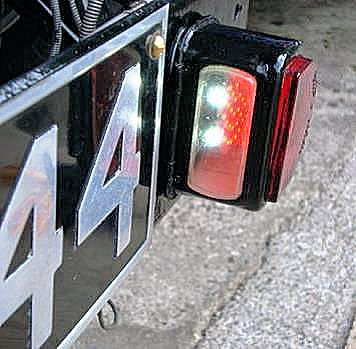
LED STOP LIGHT: Cornwall Club member Steve Baldwin has attached an
LED high-level
stop light to the rear end of his Box. It is s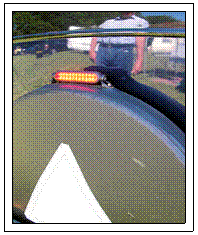 crewed firmly through
the spare wheel cover and wired-in to
the normal stop lights below. However, there is one proviso—they will only
work for 12 volt conversions, of course. They can be bought from SVC for £25
Contact Tel: 01827-67714 or ordered on-line
at
www.s-v-c.co.uk/product/small-led-high-level-brake/.
Steve Baldwin CA7C
crewed firmly through
the spare wheel cover and wired-in to
the normal stop lights below. However, there is one proviso—they will only
work for 12 volt conversions, of course. They can be bought from SVC for £25
Contact Tel: 01827-67714 or ordered on-line
at
www.s-v-c.co.uk/product/small-led-high-level-brake/.
Steve Baldwin CA7C
LED HIGH
LEVEL BRAKE LIGHT - 12V LIGHT with a 6V BATTERY
(Douglas Alderson DA7C)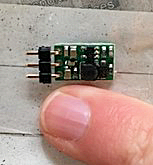
Driving to
the run in October, I noticed that one of our rear lights had stopped working, a
quick check at the start of the run failed to find the fault. Later
investigation found that the left rear tail light had stopped working but the
LED bulb was ok. The high level brake lights that came with the car, the left
light was working as a tail light even though it was not wired to the tail
lights. Further investigation found that one of the LED’s and the high level
brake light were coming apart and going to earth. As the light unit was not
possible to repair without a bodge it was time to decide what to do about the
high level brake lights.
I had looked into LED brake light units before but they all appeared to be 12v
(our car is 6v) apart from a very attractive light I spotted on the internet for
$60 plus carriage and import duties, a bit too expensive. Some time ago I
purchased from eBay a small converter 6v to 12v so you can run 12v items at 6v,
not sure how it works but only cost £0.99 inc postage from China (how they sold
it new for so little I do not know). The only problem / good point with the
converter it is very small, less than 1” long.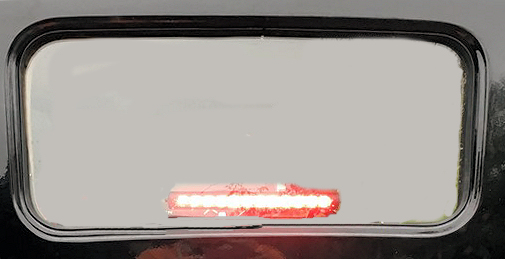
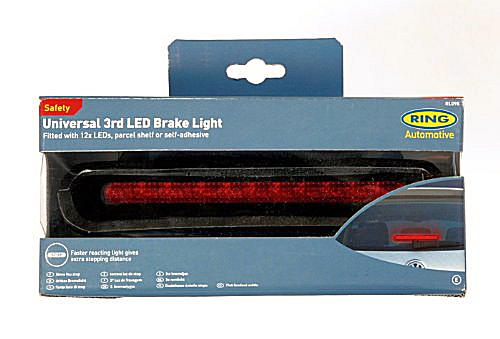
So the plan then was to find a suitable 12v LED light to use on the car, without
spending too much as it may not work. The Ring Automotive RL098 12-LED High
Level Brake Light from Amazon for £1.99 inc postage appeared to be a good option
as a test.
The brake light had a cover to fit to a sloping window which would not be
required and the light unit itself whilst a bit modern, was not too obtrusive.
The light was then taken apart to see how it worked and if it would be possible
to change the resistors to convert to 6v but this would require the circuit
board to be modified and the correct resistors fitted. I looked for a plug for
the converter but they were £5 so the wire was soldered straight on to the unit.
There are three terminals positive in, positive out and negative. Maybe not for
all but 12v on a 6v battery is useful. Douglas Alderson.
 LED STOP LIGHTS:
Ron
Hayhurst recentl
LED STOP LIGHTS:
Ron
Hayhurst recentl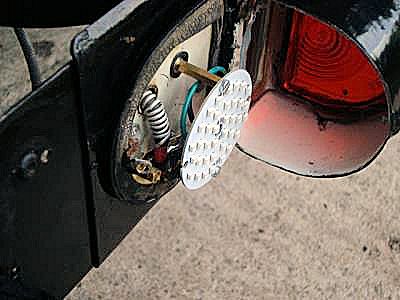 y fitted LED lights to his Box Saloon - with splendid results.
He bought them from Classic Dynamo and Regulator Conversions.
See www.dynamoregulatorconversions.com where
they show various options. From the BA7C newsletter with many thanks.
y fitted LED lights to his Box Saloon - with splendid results.
He bought them from Classic Dynamo and Regulator Conversions.
See www.dynamoregulatorconversions.com where
they show various options. From the BA7C newsletter with many thanks.
LED INDICATOR BULBS:
A
precautionary note regarding the fitting of the
LED indicator bulb
replacements. LEDs
take much less current than filament bulbs so the contact surfaces within
the trafficator arm need to be cleaned up to a bright metal finish as they
need the full 6 Volts at the bulb in order for them to flash.
Thanks
to AutoBumbler A7OC
PREVENTING LED
HEADLIGHT FLICKER: I have LED projector headlight bulbs
and they are brilliant (pun intended), but at tick-over speed the ignition
causes them to flicker although as revs increase they do become steady. This in
itself was not too much of a problem. What was though was the tendency for the
nearside light to go out after a short time, sometimes within seconds, sometimes
minutes but after switching them off and on again it would
 work
for
work
for
 a
few more seconds.
a
few more seconds.
The problem was discussed on various forums and it seemed that good earths were
absolutely necessary.
Well, I had all these as I had fitted a new wiring loom adding extra earth
returns from every light, plus an earth strap between body and engine. Still the
nearside light kept going out. I swapped the offside fittings and bulbs but
still the nearside went out. I soldered extra earths on within the headlamp
shell to no avail.
Then one day I was scrolling through posts on the Austin Seven Friends forum and
someone posted exactly the same problem that I had. A lot of suggestions were
offered including earth wires directly back to the battery, but towards the end
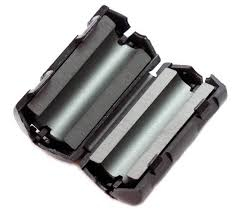
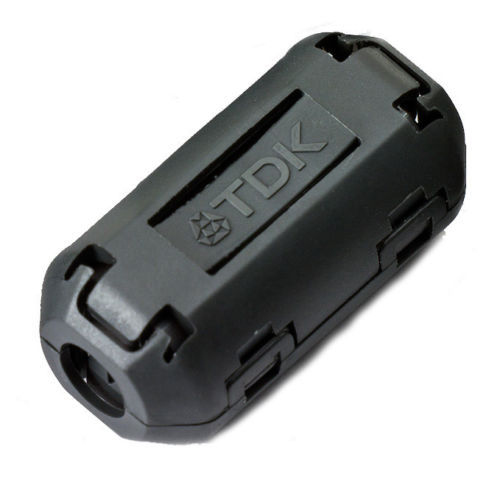
someone suggested using ferrite clips. I had never heard of them. I started
Googling ‘ferrite clips’, which were also listed variously as clamps,
suppressors, chokes and beads but all essentially the same. I had nothing to
lose by trying them so ordered four, one each for the dip and main wire on each
headlamp. They come in various sizes to suit different wire diameters. I needed
the smallest and the advice was to fit them close to the bulb. They are about
15mm long and in two halves hinged on one edge. Each half contains a magnet and
a groove to accept the wire and they are snapped shut over the wire.
I was dubious as to their efficacy as I started the engine and switched the
lights on, but they weren’t flickering. It was magic. I started it up several
times, running for short spells and still they didn’t flicker. Would that
near-side light stay on though? I drove to the church and back and it was still
on. We went for a run with headlights on all the way. They were still on when we
arrived; a miracle that only cost a few pounds.
Peter Lawson (Essex and Suffolk A7 Clubs) With many thanks.